Friday, 18 July 2014

8 Secrets To Writing The Perfect Resume

We know networking is essential today, but it will never replace the resume. A standout resume remains one of the best ways for job candidates to catch the eye of a hiring manager and make a great first impression. 
What makes a resume great? ZipRecruiter , a company that allows job seekers to upload their resumes, and small businesses, individual employers, and recruiters looking for candidates to  rate those resumes on a scale of one to five stars (one being the lowest, five the highest),  rece ntly analyzed three million resumes in its database to determine the correlation between keywords, length, and content and high ratings.
"Of course there's no such thing as the perfect resume, but some are closer to perfect than others," says Allan Jones, ZipRecruiter's chief marketing officer. "At the end of the day, the skillset of the person and their qualifications are what get them the job. But a fully optimized resume gets them recognized, gets them called in for a job interview, and gives them a leg up in a very competitive job market."
Here are eight secrets to writing a perfect (or close to perfect) resume.
ZipRecruiter perfect resume
ZipRecruiter

How To Become So Good They Can't Ignore You

speaker
Jeff J Mitchell / Getty Images
When asked for advice, comedian Steve Martin likes to say, "Be so good they can't ignore you." 
Whether you're just starting out in your career or trying to get to the next level, your goal should be to master your craft to the point where people can't help but notice. 
In his book   "So Good They Can't Ignore You,"   Georgetown University professor  Cal Newport shares his insights on how people can achieve their goals and use their skills to create a fulfilling and passionate career. 
Here are five steps to becoming so good they'll have to pay attention.

1. Don't follow your passion.
Being passionate about your work is a great goal. However, "following your passion" is not going to get you there because it has two fundamental problems.
The first is that "follow your passion" assumes that people have a pre-existing passion they can identify and use to make career decisions. However, most people have no idea what they want to do and can end up feeling lost.
The second problem lies in the assumption that if you really like something, then you'll really like doing it for a job. "We don't have much evidence that's true," says Newport. "If you really study people with meaning and passion in their work, it has little to do with whether the topic of their job matches their pre-existing passions."
He gives an example of amateur photographers or bakers who open up businesses but end up facing extreme financial difficulty that leads to unhappiness. "That's because having work that you love is a lot more complicated than, 'Hey, I like this thing! If I do it for work, I'll like my work!'" explains Newport.
Don't follow your passion. Instead, "let your passion follow you, in your quest to become so good you can't be ignored," says Newport.

2. Find a skill and career path to pursue.
Now that you understand the dangers of blindly pursuing your passion, you need to build skills.  " Try something that ' s interesting to you," Newport advises. "It doesn ' t have to be your one true passion or calling. " If you ' re stuck between two paths, flip a coin. 
The only criteria you should have for your career is that it fits your values and rewards skill with more options and flexibility.
Contrary to popular belief, there are no set skills that are intrinsically more practical than others, he says. Even if skills don't seem directly valuable, you can make up for them by making yours more rare or by reaching a high level of expertise.
For example, many people look down on English majors for being impractical. But if you can become very good at a particular type of writing, that makes you stand out, says Newport.
Don't worry about loving your job from the start.  Newport believes that passion is a side effect of mastery. "If you study how people end up passionate about their work, the most common answer is that their passion developed over time, after they built up skills that are rare and valuable," he says.
If you don't feel your engagement or interest in your work growing as you work on the skill, you're probably not developing the skill fast enough, not becoming rare or valuable enough, or you didn't choose a field that matches your values. If you recognize this, don't be afraid to switch career paths.

3. Master that skill through deliberate practice in order to gain career capital.
Once you ' ve settled on a career path, it ' s time to master the skills you need to become irreplaceable. Once you do, you ' ll gain career capital that you can offer in return for a great job.
"Until you become good, you don't have leverage," says Newport. The more mastery you have over your skill, regardless of the field, the more control and satisfaction it'll give you in your career.
When working to improve your skill, watch out for a common mistake: If you simply show up and work hard every day, you'll hit a performance plateau and stop getting better. "Many workers build their basic skills quickly at first, but once they're comfortable, they stop getting better because they're not stretching themselves," says Newport.
To avoid this, you need to use deliberate practice. "People need to train their skills like an athlete, musician, or chess player would," says Newport. Identify a clear, specific stretch goal based on something that you're not quite able to do yet, and push yourself beyond your comfort zone to get there.  Strive to tackle ambitious projects, ask for brutally honest feedback, and experiment with new ways to develop your skills.
To make sure you're on the right track, use money as a neutral indicator of the value of your skill. "People will only give you money if they're getting value for it," says Newport. "You know you're getting better at something if more money is being offered to you."
Newport calls this idea "the law of financial viability." The point is not that money is the goal, but that money is a great source of honest feedback. If you don't see people giving you an increasing amount of money for what you're doing, then you're not getting that much better at it.

4. Use your mastery to negotiate for more control in your job.
"Once you're really good at something, that by itself isn't enough," says Newport. "You have to use your skills as leverage to take control of your working life, whether through your work hours, vacation time, or projects."
Take control of your career to gain benefits that resonate with you. For example, if you are a television writer, once you have established a strong portfolio, you will have the opportunity to choose the specific shows you want to work on and collaborate with any big name you desire. When your skills become valuable enough, finding clients will never be a problem again.
The better you are, the more doors will open for you.  You'll have the freedom and flexibility to jump for whatever opportunity seems most promising to you.

5. Find your mission.
"One way to find great meaning and satisfaction in your work is to end up with a mission that organizes your goals and working life," says Newport. You don't need to have a mission to love your work, but it's a common thing that most people want to pursue.
However, finding your mission is one of the last steps you should think about. "The most important thing to recognize is that you don't just start with the mission and go off and pursue it," says Newport. "I f you study people who actually have meaningful missions in their life, they start by getting really good in their field at first."
This is because a career mission is similar to a scientific breakthrough — it's an innovation at the very cutting edge of your field, so you can't know about it until you get there.  Only when you establish strong expertise can you really  identify a real, sustainable, impactful mission.
There's no way to escape it: You have to get really good at something before big things start to happen.


15 Things You Should Never Say In A Salary Negotiation

You secured the interview, brought your A game, and landed the job. Now comes the hard part: negotiating your salary. 
"Salary negotiations are like any other type of negotiations — except the words you use can be extremely powerful, since there is a personal aspect to the discussion," says HR expert Steve Kane. "The negotiation is not over the worth and price of an inanimate object, but rather the value of you to some enterprise."
Here are 15 words and phrases that may hurt more than they'll help in a salary negotiation:  
"I accept [the first offer]."
Remember: This is a negotiation, so be careful not to end it before it has even had a chance to start, says Ryan Kahn, a career coach, founder of The Hired Group, and author of "Hired! The Guide for the Recent Grad." 
"I'm looking for X."
Never throw out the first number. "You want to leave room for discussion," says Lynn Taylor, author of " Tame Your Terrible Office Tyrant: How to Manage Childish Boss Behavior and Thrive in Your Job ."
Kahn agrees. "A good negotiation strategy is to let the employer offer the first number. That puts you in a position to see the number they are offering and gives you the opportunity to negotiate it up from there."
"That's all you're offering me?"
Never say this, or anything else that will offend the employer — even if you think the salary they're offering is laughable. 
"No."
"In negotiations, you'll have to be willing to be flexible and provide counteroffers when the offer isn't in line with what you are seeking," says Kahn. By saying "no" you could be quickly closing the door on the offer at hand.
"I have other outstanding offers right now that are much more lucrative."
Even if it's true, you shouldn't use "that card" to pressure the employer, Taylor says. "Only discuss the offer at hand."
And if you don't have another offer on the table, you'll definitely want to avoid this tactic. " You could shoot yourself in the foot," Taylor says. "The hiring manager may ask you to elaborate and if you're bluffing, it'll be hard to save face."
"Bottom line"/"This is my final/last offer."
These phrases sounds like threats, and they typically close out the negotiation, says Kane. "If you say any of these things, and the demand is not met by the employer, the negotiation will be over and you'll have to be prepared to walk away." 
"I know this may sound a little aggressive, but..."
If your rationale is based on fact, you should never have to preface your request with this type of disclaimer.
"I need..."
You should never say you need X amount more because of expenses or debt. "Don't bring in personal issues; this is about your merit and the job fit," says Taylor.
"I hate to have to ask for this, but..."
True, it might not be the easiest thing to ask for more money — but saying you "hate to have to do it" is a flat out lie. Plus, it's just a really terrible way to preface the negotiation.
"I think..."
Don't use "I think" or "maybe" or any other "uncertain words," says Jessica Miller-Merrell, editor ofBlogging4Jobs.com and CEO of Xceptional HR. "Always speak confidently."
"The least I'd be willing to accept is X."
If you tell them the parameters of the lowest offer your willing to take, that could be what you'll get. 
"Sorry"
Have confidence in yourself. "If you know your value and what you'll be bringing to the company, there will be no need to apologize for asking for more," Kahn says.  
"Cheap"/"Lousy"
These words are demeaning or disrespectful to the employer, Kane explains. "The employer may decide they don't want you to work there after all because of the lack of respect you show them."
"But I'm worth so much more."
Of course you'll want to mention your value in a salary negotiation — but try to say it in a way that isn't so obnoxious. You never want to come off as arrogant. 
"You might not think I'm worth this, but…"
Just don't.
"You want to be direct, polite, and concise in your negotiation to show that you are competent and a valued member of the team," Miller-Merrell concludes.

Thursday, 17 July 2014

This cat is 'purr'manently sad!

This cat is 'purr'manently sad!

With downcast eyes and an upside-down smile, there's a new feline in town to rival Grumpy Cat.

The mournful kitten, whose photographs appeared on Imgur this weekend, is owned by Ashley Herring and currently has no name.

Due to its woeful expression, the female kitten has earned the temporary nickname Purrmanently Sad Cat or PSC for short.

Source: http://www.rediff.com/news/slide-show/slide-show-1-wtf-news-its-weird-true-and-funny/20140711.htm#13

This boy is the coolest in town


This little lad is the coolest boy in town in more ways than one after his dad made him a pair of watermelon underpants.

Ruifeng Fan, 33, from Taipei in Taiwan fashioned the pants to help five-year-old son Hao beat the summer heat.

The tot was always complaining about being too hot but the family had no swimming pool for him to cool down in.

Ruifeng said: "I gave him a watermelon to eat, which is usually the best way to cool down, and after cutting out the inside I suddenly thought that actually the watermelon itself could probably be used to make a really cool pair of underpants.

"So I cut out two holes for his legs and fitted it with a makeshift pair of braces, and he instantly had the coolest underpants in town.”

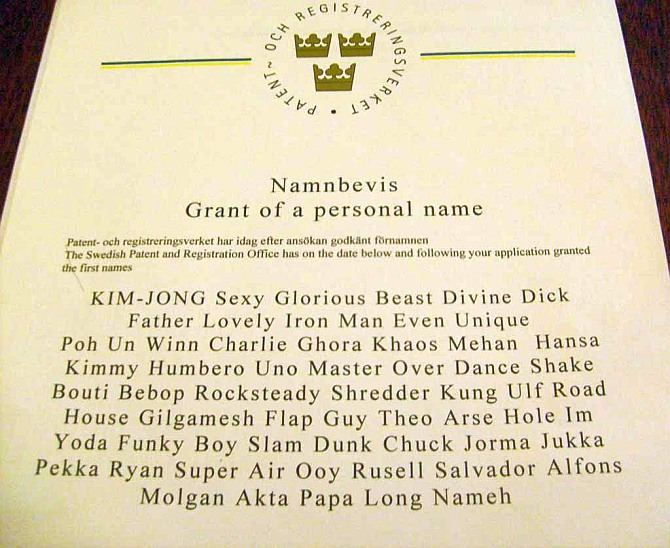
Swedish man's 63-word name may be world's longest


A 25-year-old man in Sweden whose first name contains 63 words may have the world's longest name.

The young man's name is Kim-Jong Sexy Glorious Beast Divine Dick Father Lovely Iron Man Even Unique Poh Un Winn Charlie Ghora Khaos Mehan Hansa Kimmy Humbero Uno Master Over Dance Shake Bouti Bepop Rocksteady Shredder Kung Ulf Road House Gilgamesh Flap Guy Theo A*** H*** Im Yoda Funky Boy Slam Duck Chuck Jorma Jukka Pekka Ryan Super Air Ooy Rusell Salvador Alfons Molgan Akta Papa Long Nameh Ek.

Pilot orders pizza for delayed passengers


Storms earlier this week in Denver, US saw dozens of services disrupted, including Frontier Airlines Flight 719 from Washington DC’s Reagan National Airport. 

The aircraft was approaching Denver, Colorado, but severe weather prevented it from landing, and then low fuel saw it diverted to Cheyenne, Wyoming, where it was forced to wait for several hours. 

Captain Gerhard Bradner took pity on his passengers, however, and reportedly ordered dozens of pizzas on his personal account, which were delivered to the 160 passengers waiting on board the Airbus A320.


Coffee house serves thirsty customers drinks in blood bags


A vampire-themed restaurant is offering their customers drinks in blood bags.

Twilight fans will no doubt rejoice at the news that they can get their serving with an Edward Cullen twist at the coffee house in Benxi city in northeast China’s Liaoning province.

On offer are some popular red drinks such as wine, cherry cola and blackcurrent juice which will all come served in the blood bags to give the illusion that you're getting your latest fix.

But have no fear, if it's coffee, fruit juice or mineral water you're after then all these liquids can be stained red before being served up.

Food is also on offer, often with a generous portion of ketchup to satisfy the theme.

Singapore bans book based on Central Park Zoo's 'gay' penguins


Singapore is putting the freeze on a children’s book about the Central Park Zoo’s “gay” penguin couple — by taking copies from ­libraries and ­destroy­ing them. The country’s National Library Board will pulp three copies of “And Tango Makes Three”, claiming the tale is inappropriate, government officials said.
“We support teaching children about conventional families, but not about alternative, nontraditional families,” said Yaacob Ibrahim, the country’s minister of communications. The approach is to reflect existing social norms, and not to challenge or seek to change them.”


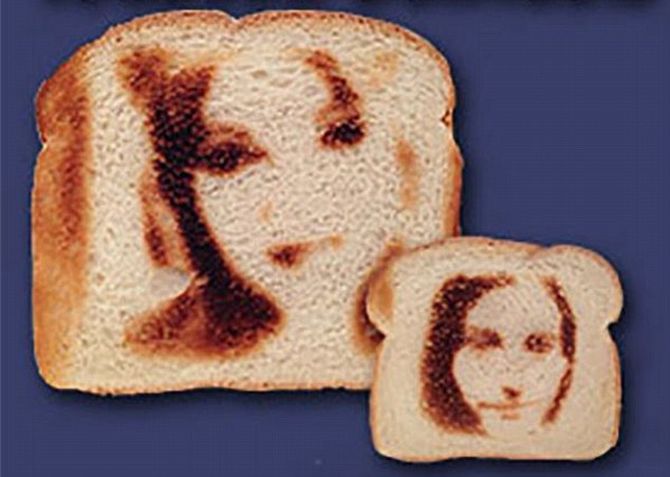
New toaster can burn YOUR face into bread


We've seen Jesus in toast form. but now a new novelty toaster is allowing the selfie-obsessed to burn their own image into their morning slice.
The Vermont Novelty Toaster Corporation now offers a service by which customers' photos are used to create personalized toasters.
The finished products - which retail for $75 apiece -- lightly grill bread to a golden brown, save for the image outline which is burnt on at a higher heat to make for a darker hue.